Top Silicone Baby Bibs for Wholesale Buyers
Choosing the right Silicone Baby Bib for wholesale is about more than comparing unit prices. Buyers need to assess material quality, fit, cleaning, packaging, and supply consistency together. A soft, flexible bib with a rounded catch pocket may suit daily feeding, while a secure adjustable neck closure can help accommodate different stages. Small details matter. A pocket that collapses easily, for example, may be less useful than one that stays open during a meal.
This guide explores features that wholesale buyers can examine before placing an order. We consider material specifications, construction, sizing, color options, minimum order quantities, and sample evaluation. Ask suppliers for clear product details, care instructions, and information about quality checks. Then inspect a physical sample when possible. Feel the edges. Fasten and release the closure several times. Check whether the bib sits comfortably and whether food residue can be rinsed from its folds.
There is no single best choice for every retailer or customer. A lower purchase price may look attractive, but inconsistent finishes or unclear product information can create extra work later. That deserves a second look. Use the comparisons and buying considerations ahead to match product features with your customers, sales channel, and storage needs. Supplier communication can also vary, so confirm important details in writing before ordering. A careful review will not remove every uncertainty, but it can make wholesale decisions more informed and practical.
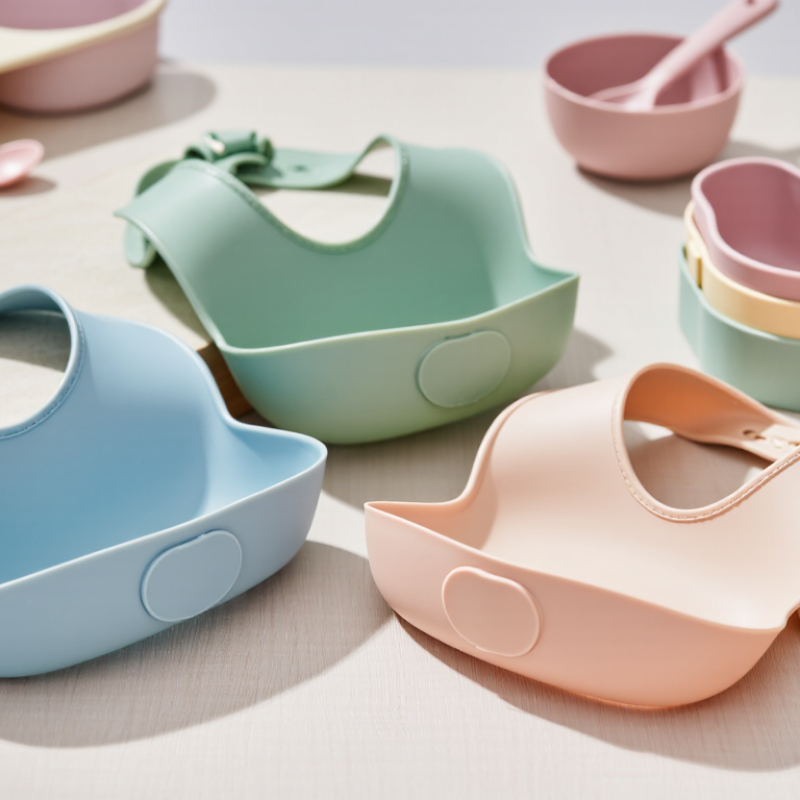
Silicone Baby Bib Types: One-Piece, Foldable, and Adjustable Designs
One-piece silicone bibs have a continuous body and catch pocket, with few seams to trap food. For wholesale buyers, that can simplify cleaning and reduce small parts. Still, inspect bib width, neck opening, and pocket shape on samples. A stiff opening may feel uncomfortable, while a very soft pocket can collapse against the chest. Fit matters.
Foldable designs pack flat, making them useful for travel sets and compact retail displays. Check how easily the bib folds after washing, and whether creases collect residue. Some models use thinner silicone to stay flexible. That saves space, but may feel less stable during meals. Simple, but not universal.
Adjustable bibs use snaps, buttonholes, or similar closures to fit different neck sizes. More settings can extend the usable fit, though closures need careful inspection for secure attachment and comfortable edges. Compare adjustment ranges across sizes rather than relying on a single sample. No design wins every table. Ask suppliers for material specifications and relevant test reports for the intended market, then compare samples from separate production runs. Consistency can be harder than the product photos suggest.
Food-Contact Safety: Verify Applicable U.S. and EU Compliance
For wholesale buyers, a silicone bib’s smooth surface is not proof of food-contact safety. Start by confirming how the product is intended to be used: food may rest in its pocket, and crumbs can sit there for hours. The details matter.
In the United States, ask which applicable FDA food-contact requirements cover the silicone formulation and its intended use. “FDA approved” is not enough on its own; the finished bib may not receive individual FDA approval. In the EU, check relevant requirements under the food-contact framework and good manufacturing practice rules. Silicone does not have one fully harmonized, EU-wide specific measure, so national requirements may also matter. Ask for current technical documents and test reports for the finished product, not just raw silicone. Look for migration testing suited to the likely foods, temperatures, and contact time. Check that pigments and other additives are covered.
Keep the paper trail. Request batch traceability, a clear material specification, and written confirmation of the tested product configuration. A report for a different color or design may not answer your question. It is easy to overlook that. If evidence is vague, ask the supplier to clarify the test method, laboratory, and applicable market before placing a large order.
Top Silicone Baby Bibs for Wholesale Buyers: U.S. FDA Extractives Limits
The bars show maximum extractives under the conditions specified in 21 CFR 177.2600 for applicable repeated-use rubber articles—not test results for any bib. Confirm that the material and intended use fall within the regulation before relying on these limits. In the EU, Regulation (EC) No 1935/2004 and good manufacturing practice rules apply; there is no harmonized EU-wide silicone-specific measure, so verify applicable national requirements and supporting migration or safety documentation.
CPSIA Benchmarks: 100 ppm Lead and 0.1% Phthalates Limits
For wholesale buyers, a silicone baby bib is more than a soft, wipe-clean product. Its materials and attached parts deserve careful review. CPSIA benchmarks commonly include a 100 ppm total-lead limit for accessible components of covered children’s products. That is a small amount, but pigments, printed details, clasps, or snaps can affect test results. Small details matter.
The phthalate benchmark is 0.1%, or 1,000 ppm, for each restricted phthalate in applicable accessible components. This requirement applies to covered toys and child-care articles, so confirm how the finished bib is classified and which components fall within scope. Silicone alone does not tell the whole story. A bib may include other materials, and a supplier’s general statement is not a substitute for product-specific evidence.
Before placing a large order, request relevant test reports from a qualified laboratory and check that the tested materials match the production specification. Review colorants, coatings, closures, and any flexible plastic parts, not just the main silicone panel. Compare report dates, sample descriptions, and product versions with the goods you plan to buy. Batch changes can matter. Paperwork can look convincing, yet still describe an older sample; that gap is worth questioning.
Wholesale Comparison: MOQ, Case Packs, Pricing, and Customization
Top Silicone Baby Bibs for Wholesale Buyers
Wholesale comparisons work best when MOQ, case packs, and landed cost appear side by side. Grand View Research estimated the global baby care products market at USD 9.8 billion in 2022, with projected growth through 2030. This broad category is not a bib forecast, but it signals a substantial market for baby essentials. Ask suppliers to quote the same order quantities, such as 100, 500, and 1,000 pieces. Compare unit price, sample fees, freight, and any mold or logo charges.
Case packs affect storage and cash flow. A carton of 24 bibs may suit a small retailer; a 48-piece pack may lower handling costs but tie up more capital. Confirm carton dimensions, gross weight, and whether colors can be mixed within one case. For customization, specify logo placement, color matching, packaging, and acceptable production tolerances in writing. Request a pre-production sample. Small details matter: a stiff neck opening or shallow catch pocket can prompt returns. Price alone misses that.
Tips: Ask for a tiered quote and the exact MOQ for each color. Check whether the quoted price includes custom packaging. One detail is often overlooked: confirm how defects are handled before placing a larger order.
Supplier Checks: REACH SVHC Communication Threshold Above 0.1% w/w
Top Silicone Baby Bibs for Wholesale Buyers
For silicone baby bibs, ask suppliers how they assess REACH SVHC communication above 0.1% w/w. Under REACH Article 33, the threshold applies to an individual article, not automatically to the whole bib. A silicone body, detachable clasp, or printed component may need separate consideration. This distinction matters.
ECHA’s Candidate List update of June 2024 recorded 241 entries. The list changes over time, so date each declaration and identify the list version used. Ask for a signed material declaration, component-level SVHC screening, and supporting test reports with sample IDs, dates, and tested materials. A report covering only the silicone body does not establish the status of a clasp. Small detail. Often missed.
If an SVHC exceeds 0.1% w/w in an article, suppliers must communicate sufficient information for safe use; at minimum, this includes the substance name. ECHA also states that consumers can request this information and must receive a response within 45 days.
For wholesale checks, reconcile paperwork against the bill of materials and production batch. Testing cannot prove every batch is identical, so keep change-control records and repeat checks when materials or suppliers change. A spreadsheet alone is not enough.